
There is no “Incoterms 2026” or “Incoterms 2025.” The current and only valid edition is Incoterms 2020, published by the International Chamber of Commerce (ICC).
The ICC has updated the rules roughly every 10 years since 1980, so the next revision isn’t expected before around 2030 — any site offering an “Incoterms 2026 PDF” is either outdated or incorrect.
What Are the 11 Incoterms
Incoterms 2020 defines 11 standardized trade terms, split into two groups: seven that work for any mode of transport (EXW, FCA, CPT, CIP, DAP, DPU, DDP), and four that apply specifically to sea and inland waterway transport — which is where most bulk dried fruit shipments fall: FAS, FOB, CFR, and CIF. Each term is broken into seller and buyer obligations covering delivery, risk transfer, insurance, and cost allocation.
FOB Incoterms
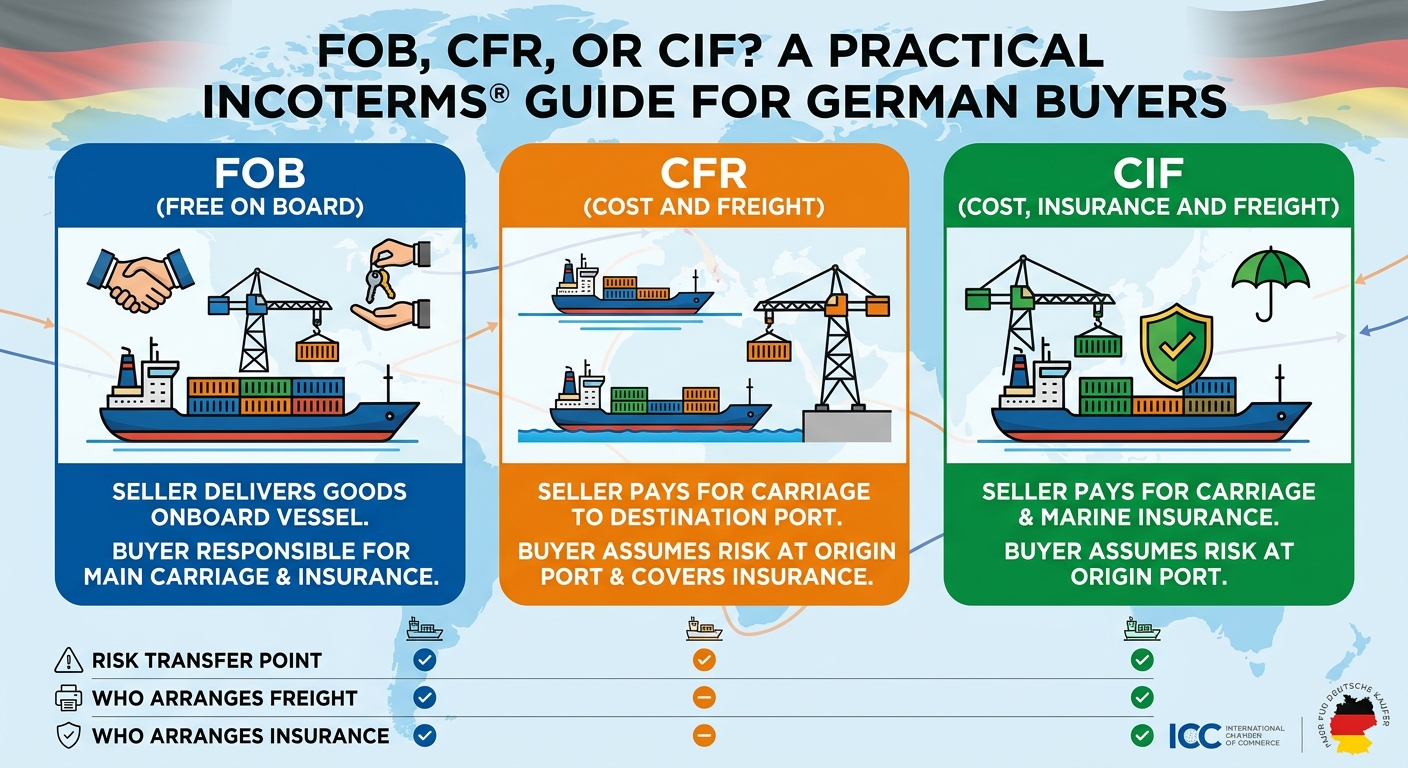
FOB (Free On Board) means the seller’s responsibility ends once the goods are loaded onto the vessel at the origin port. From that point, the buyer takes on all risk and cost — including main freight and marine insurance. FOB gives the buyer the most control over freight booking and cost, which is why larger, experienced importers often prefer it.
CFR Incoterms
CFR (Cost and Freight) means the seller pays for the goods and the freight to the destination port, but risk transfers to the buyer as soon as the goods are loaded — same risk point as FOB, different cost split. The buyer arranges their own insurance under CFR.
CIF Incoterms
CIF (Cost, Insurance and Freight) is CFR plus one addition: the seller also arranges and pays for marine insurance up to the destination port. Risk still transfers at loading, same as FOB and CFR — CIF just bundles freight and insurance into the seller’s quote, simplifying the process for buyers who don’t want to arrange coverage themselves.
CIF vs CFR: The Only Real Difference
The difference between CFR and CIF is exactly one line item: insurance. Everything else — risk transfer point, delivery obligation, freight payment — is identical. Buyers who already have standing marine cargo insurance policies (common among larger importers) often prefer CFR, since paying for insurance twice adds unnecessary cost.
FOB or CIF: Which Is Better for You
Neither is universally “better” — it depends on what the buyer wants to manage:
| FOB | CIF | |
|---|---|---|
| Who books freight | Buyer | Seller |
| Who arranges insurance | Buyer | Seller |
| Best for | Buyers with their own freight forwarder and insurance relationships | Buyers who want an all-in landed price with fewer moving parts |
| Price transparency | Buyer sees freight/insurance costs separately, can shop rates | Bundled into one seller quote |
For a first-time German buyer working with a new supplier, CIF is often simpler to evaluate and compare. Buyers with established logistics operations — larger wholesalers moving regular container volumes — typically prefer FOB for cost control.
How We Quote
We offer FOB, CFR, and CIF pricing on request, depending on your logistics setup and whether you have existing freight or insurance arrangements. Every quote states the Incoterm explicitly, along with the named port, to avoid ambiguity on where risk and cost actually transfer.
For our complete export process, see the Germany export page.