
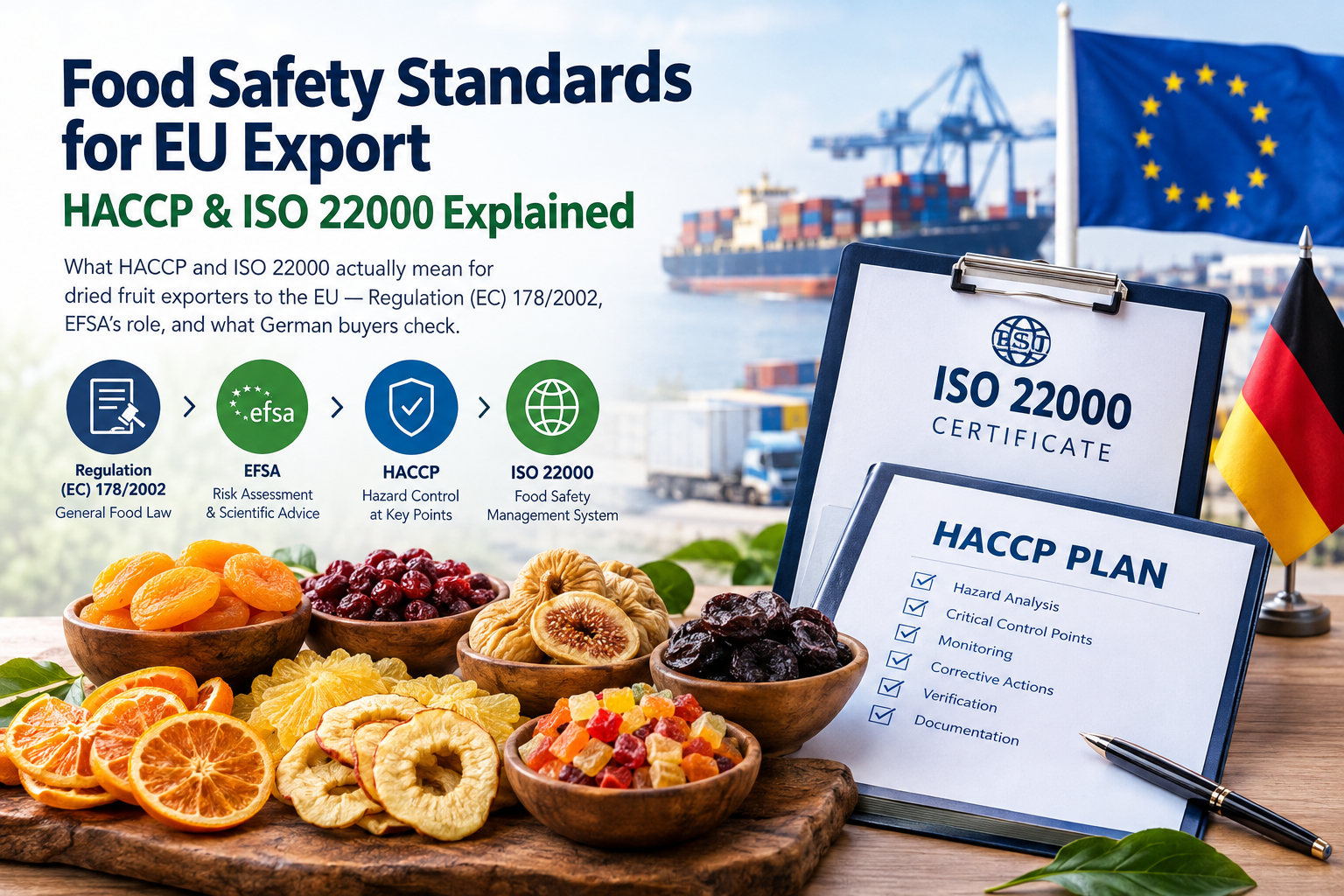
Any food business shipping into the EU operates under Regulation (EC) No 178/2002 — the General Food Law — which set up the European Food Safety Authority (EFSA) and made food safety compliance a legal obligation, not a best practice, for every operator in the supply chain, from primary producer to importer.
What Regulation (EC) 178/2002 Actually Requires
This regulation is the legal foundation everything else sits on. It puts the primary responsibility for food safety on the food business operator (not the government), requires full traceability — meaning you must be able to identify where an ingredient came from and where the product went — and requires a documented withdrawal/recall procedure if a safety issue is found after shipment.
HACCP: The Operational Layer
HACCP (Hazard Analysis and Critical Control Points) is the practical system built on top of that legal foundation. Before HACCP procedures apply, a facility first needs Good Hygiene Practices (GHP) and Prerequisite Programmes (PRPs) in place — HACCP identifies the specific hazards that hygiene practices alone don’t fully control, and sets Critical Control Points (CCPs) to manage them.
For dried fruit and dehydrated vegetables, the hazards HACCP typically targets include moisture-related mold growth, foreign material contamination during drying/sorting, and cross-contact with allergens during processing.
ISO 22000:2018 — HACCP Inside a Full Management System
ISO 22000 isn’t a replacement for HACCP — it wraps HACCP principles into a certifiable Food Safety Management System (FSMS) that also covers management commitment, internal audits, corrective action tracking, and continual improvement. A supplier holding ISO 22000 certification has HACCP built in by definition, plus a documented system auditors can verify year over year.
| HACCP | ISO 22000:2018 | |
|---|---|---|
| What it is | A hazard-control method | A full certifiable management system |
| Certification | Not independently certifiable | Certifiable by accredited bodies |
| Scope | Specific hazards at specific process steps | Entire food safety management, including HACCP |
| Who checks it | Internal QA, customer audits | Third-party certification body, recurring audits |
| What German buyers ask for | Documented HACCP plan | ISO 22000 certificate (often the higher bar for retail buyers) |
Who Sets and Enforces These Standards
Policy and legislation come from the European Commission’s Directorate-General for Health and Food Safety (DG SANTE). EFSA carries out independent risk assessments — including its lists of substances and additives that are restricted or banned in food — that feed into what DG SANTE regulates. Enforcement at the German border and in-market happens at national and state level, checking that imported goods match the documentation on file.
What This Means for a Buyer Sourcing Dried Fruit
A supplier that can produce a current HACCP plan and, ideally, ISO 22000 certification is signaling that hazard control isn’t ad hoc — it’s documented, auditable, and traceable back through the batch. That’s what German import QA teams and retail buyers check before a first order, and again before a repeat one.
What we ship under this standard: Dried Apple, Dried Apricot, Dried Fig, Dried Orange, Dried Cherry, Dried Plum, Dried Aloo Bukhara, Dried Peach, Dried Lemon, Dried Fruit Cube, and Dried Fruit Dice. Full dried fruit range.
For our complete compliance and export process, see the Germany export page.
Alaina1960
For a first dried fruit order, would you normally provide the HACCP plan along with the product specifications and lab reports?
afruit
Yes. For a first order, we can provide the relevant HACCP documentation, product specifications, and available laboratory reports for your quality review.
Email: iranianfruit@gmail.com
Tell: (+98 21)65018726
WhatsApp: +989124663086